Showing posts with label wheelchair travel. Show all posts

Monday, June 1, 2020

Adaptive Recreation Creates Opportunity, Supports Local Economies

Paraskier making a sharp turn on the ski slope
MoveUnited.org
Even before the ADA was signed into law, people living with disability—and their families and friends—found ways to pursue interests in sports and the outdoors. There are many pioneers in the field, including Jim Winthers, a veteran connected to the 10th Mountain Division in WWII. He found models in Europe to help returning veterans learn to ski after losing limbs. As they say, necessity is the mother of invention, and where there's a will, there's a way...

As a former volunteer with Splore in the 80s, it was great to learn from the diverse client base about their personal motivations to get outdoors and ski, raft, climb or paddle. What stuck with me was a common request from folks using wheelchairs during overnight rafting trips on the Colorado River:
I'd like watch the river for a while and be alone...
We all benefit from solitude, the sensation of wind and sun or the natural sights and sounds of water, landscape and open sky. This doesn't change for those with disabilities involving mobility, sensory or developmental issues. The other thing I learned from fellow volunteers (who were wheelchair users themselves) was their value for roadless areas and wilderness—even when that meant they couldn't visit easily. While others might feel differently, the knowledge that those areas were preserved in a natural state was as important to them as it was to anyone else.

To get a sense of the experience of one wheelchair user running the Colorado—from an unintentional swim to using the camp 'groover'—see this piece featured on WheelchairTraveling.com, Rafting the Colorado with a Wheelchair, by John W. Mitchell.

As we all adjust to a world with #COVID-19, guides, outfitters and others in the recreation-tourism industry are anxious to accommodate clients again safely. With more than 12% of Idaho's population living with some form of disability, that's a market share worth welcoming into your lodge, shop, cabins, boat and restaurant. As we like to remind retail, travel and tourism professionals, by welcoming people of all abilities into your business or activity, you're also welcoming their entourage...friends, family, co-workers, etc.

Idaho is a state with exceptional recreational and landscape values—and an economy based largely on providing access to those places. Boise's Ridge to River trail system features several wheelchair-accessible trail segments that let more folks explore the landscape, fresh air and views around the city.
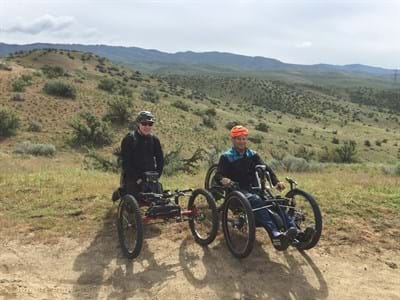
Two adaptive cycle users stopped on a foothills trail overlooking the City of Boise.
Copyright, Ridge to River

Splore is now part of the National Ability Center. One look at their program list will give anyone a sense of the potential available to both individuals and local businesses. Whether it's hunting, fishing, skiing, bird watching or boating, Idaho has much to offer.

And in some cases, outdoor recreation depends on simple policies and community support and engagement. As community members, we should all consider the landscapes we move through and pay attention to basics: trail width and surface, potential hazards from high-speed bike traffic, and designated ADA parking options and entries to trail segments considered 'accessible.' It's time to demand more inclusive planning and design of our use of the natural and built environment funded and used by the public.

We all benefit from time outdoors in many ways: physically, mentally, emotionally and spiritually. It's not a matter of altering open space to remove all risk; it's a matter of making changes that promote more inclusive exploration. As the original Splore web site puts it so well,
...there is dignity in risk-taking and that it is an inherent part of living a full and robust life.

Woman and guide dog navigate downhill sandy trail flanked by dry grass with blue sky above.
Photo, Erik Kingston


Access Means Business, Access Means Inclusion, Access Means Adventure, Access Means Freedom

What are we waiting for?

Friday, May 16, 2014

Reaching Out Persons with Disabilities - Ten Lessons

Parents, grandparents, and children arrive at a hotel for vacation.
Some great information from the ADA for small business. Getting people in the door is just one aspect of expanding markets and providing goods and services to persons living with disability.

"Did you know?

  • More than 50 million Americans with disabilities - 18% of our population - are potential customers for businesses of all types across the United States.
  • This group has $175 billion in discretionary spending power, according to the U.S. Department of Labor. That figure is more than twice the spending power of American teenagers and almost 18 times the spending power of the American "tweens" market.
  • Accessibility attracts not only people with disabilities but also their families and friends. Like others, these customers often visit stores, restaurants, movie theaters, and other businesses accompanied by family or friends. This expands the potential market exponentially!
  • This market is growing fast. By the year 2030, 71.5 million Baby Boomers will be over the age of 65 and demanding products, services, and environments that address their age-related physical changes."
http://www.ada.gov/reachingout/intro1.htm


Monday, December 2, 2013

Cycling infrastructure means new pathways for all

Check out this video of cycling infrastructure, or 'infra,' in the Netherlands. A leader in bike- and pedestrian-friendly communities, Dutch culture is equally friendly in terms of universal access. Both stakeholders that use wheelchairs and cyclists find common cause in advocating for safe routes that connect neighborhoods, communities and recreational amenities.

As Idaho's statewide Bike and Pedestrian Advisory Committee (BPAC) and other mobility planners explore options to expand transportation choices, keep this video in mind. To learn more, call Erik at 208.331.4706.

Who else benefits from Dutch cycling infrastructure?
http://www.youtube.com/watch?v=xSGx3HSjKDo

(Photo: Chuck Humel)
Some ingenious ways to combine bike and wheelchair commuting with friends and family:
(Photo: tmannetje.nl)
See also: http://www.frankmobility.com/duetfeat.php

Wednesday, June 19, 2013

Access Means Business

Photo credit: Disability Action Center NW
Current demographics show that not only are Baby Boomers an economic force, they also indicate that one in ten Idahoans (read: potential customers and tourists) lives with some type of mobility impairment. Nearly 22,000 Idahoans living with a disability earn more than $50,000/yr. This means communities with accessible and inclusive housing, retail, public and recreational spaces will be the winners moving forward.

Wheelchair users are mobile, and they're looking for travel and adventure opportunities like anyone else. It pays to make them feel welcome.

More online resources are available every day to these travelers, whether aimed at historic tourism, zip-line courses, skiing and boating...not to mention hunting and fishing. Idaho should be a draw to these visitors (we have the best of all these, right?), but only if we begin to think about access in our planning process. If you aren't convinced that wheelchair users are pushing the envelope, check out this video.

One of the best sites to illustrate access-related travel reviews is www.wheelchairtraveling.com. The site provides travel tips on air and ground transportation, lodging and inclusive tour options or travel packages. An example of one such review can be found here; a wheelchair POV video of the trip is here. Big props to WCT's Creatrix Ashley Lyn Olson for her amazing documentary skills. What would Ashley have to say about your town?

Our group would love to talk with local businesses, planners, chambers and leadership to assess the visitor-readiness of your streets and spaces, and help you gain some traction towards increased economic activity and compliance with existing laws. Visit us on Facebook or email info@rampupidaho.org to let us know how we can help.

Photo credit: www.wheelchairtraveling.com