Saturday, May 24, 2025

2025 Hands Around the Capitol

 2025 Hands Around the Capitol


Please join us for Hands Around the Capitol 2025, kicking off a three-month celebration of the 35th Anniversary of the Americans with Disabilities Act (ADA) on July 25, 2025 from 10am to 4pm in Cecil Andrus Park in Boise, Idaho. This is a statewide in-person, educational and awareness event that will be connected by live streaming platforms to coordinate with national ADA celebrations and awareness events across our nation.

Want to get involved? We're still looking for sponsors and vendors to support and participate in this celebratory event. Support here

Big News!
NaviLens: We're featuring this groundbreaking navigational and interpretive technology to help us celebrate the Ada, and to support inclusive business, travel, and tourism while highlighting the needs of folks with sensory disabilities, neurodiversity, or alternate language needs.

NaviLens is an adaptive technology that helps people of all abilities and communication preferences to navigate spaces and access interpretive information. Learn more through this YouTube overview.

What sets NaviLens apart from standard QR codes? (from the NaviLens FAQ Page:
"The NaviLens Accessible QR Code can be read from much further away, within an angle of up to 160 degrees and on the move. This allows its use without the need to focus or frame the code on the mobile screen. The user does not need to know exactly where the codes are and can therefore be used by blind or vision impaired people. In addition, the user experience is much more satisfactory as it is much faster and easier to use.
Blind people or anyone with low vision in general struggle to use a QR code because they do not know where it is placed and so have great difficulty focusing and framing it. The NaviLens Accessible QR Code does not need to be focused or framed and can therefore be used by everyone."
Download the Navilens app for either iPhone Apple iOS or Android Google Play


Friday, March 10, 2023

2023 Rocky Mountain Land-Use Institute

Ramp Up Idaho and Idaho Access Project members shared updates on inclusive planning and design efforts with the audience of RMLUI's Western Spaces, Western Places conference at the Sturm College of Law at the University of Denver Campus. We were joined by colleagues from the City of Boise and Vitruvian Planning. 

Session description below:


Asking Directions: Experts with Disabilities Lead the Way

The Idaho Access Project’s 2020 RMLUI session, “Count Us In,” made an argument for more inclusive planning and design. We’ll present case studies from several subsequent local and statewide initiatives that illustrate the value of this collaboration for all partners. First, we’ll focus on our supportive work with Vitruvian Planning on three projects:

  1. Residential neighborhood access audit;
  2. Repurposing a downtown restaurant and business district from a through street to pedestrian and patio use; and
  3. ADA Transition Plan for the City of McCall, ID to evaluate transportation corridors, and key buildings and districts.

The overall theme of the session is 'active engagement’ with community partners to overcome cultural or institutional barriers that can stand in the way of meaningful partnerships and mutual trust and understanding.

Moderator:

  • Erik Kingston, Housing Resources Coordinator, Idaho Housing and Finance Administration

Speakers:

  • Sean Keithly, Director of Economic Development, Boise
  • Don Kostelec, Principal, Vitruvian Planning, Boise
  • Carol Baron, Idaho Access Project, Boise
  • Jeremy Maxand, Executive Director, Living Independence Network Corporation (LINC)

Thursday, November 17, 2022

Idaho Access Project: Making a Difference

Opening slides from four IAP presentations, clockwise from top left.
One Idaho For All: Best Practices in Local ADA Transition Planning; Count Us In! Inclusive Planning and Design for Community Health, Mobility and Safety; Access Means Business: Policies for Compliance, Community and Commerce; and Don't Miss the Boat! Expanding accessible travel experiences for all.

It's been a busy year for the Idaho Access Project! The IAP is a volunteer-driven, 501c3 nonprofit initiative to promote greater access and inclusion in all aspects of Idaho life. Founded by Dianna Willis, Jeremy Maxand, and Dana Gover in 2018, they were joined by Erik Kingston in 2020. Kingston and Gover were also original founders of Ramp Up Idaho, and the groups share some key goals:

  • Increase safety, independence, mobility and access for all Idahoans
  • Focus on building positive relationships and productive collaboration
  • Promote awareness of the universal benefits of access to all stakeholders
  • Show that #accessmeansbusiness and #accessmeansinclusion
In the past 12 months, IAP has been making change in a number of areas.

Community Access and Safety. IAP subcontracted with Vitruvian Planning on two municipal projects: Boise's 8th Street conversion to a patio and pedestrian zone between Bannock and Main, and the City of McCall's ADA Transition Plan. This fee-for-service income covers out-of-pocket and other hard costs for travel and outreach. Board members and volunteers also serve on Boise's Cross-Disability Task Force. IAP identified a safety concern in the bike ramps adjacent to roundabouts related to the lack of tactile surfaces to help pedestrians who are blind avoid walking into traffic; the local Highway District (ACHD) now plans to address the hazard.

Visitability Standards for Single-Family Housing. IAP members have long worked to raise awareness of the importance of residential development that reflects the basic features of Visitability. This includes one zero-step entrance; 32" clear doors and passageways on the main floor; and a main floor bathroom usable by someone in in a wheelchair. IAP's work highlights the many benefits of inclusive residential design and construction for individuals, taxpayers and community integrity. IAP members produced a Visitability podcast at the LINC Idaho studio, and two video interviews on the difference between planning ahead for access and modifying an existing inaccessible home (aka, 'Planning Behind"): Visitability by Design: Creating Community and Overcoming Design, Safety, and Financial Barriers

Conferences. IAP members presented at conferences for the Association of Idaho Cities the APA Idaho Chapter (both in Boise), and a keynote for the Idaho Conference on Recreation and Tourism (ICORT) in Twin Falls. They were also invited speakers for the November Boise Rotary Club, and addressed Idaho's Regional Economic Development Professionals December meeting.

Recreation. IAP Board members and volunteers worked successfully with the City of Boise and Ridge to Rivers to identify and address barriers to lower foothills trails. IAP members, family and friends planned and completed the Access Idaho Adventure tour of North Idaho to explore accessible and inclusive travel and recreation opportunities. They created a video of the trip and presented their findings to the Idaho Tourism group at Idaho Commerce, and the ICORT conference mentioned above. IAP facilitates the statewide ADA Recreation Committee via zoom, to connect with peers interested in adaptive outdoor recreation and travel.


Civic Life and Volunteerism. IAP was invited to partner for a second year with the WCA Boise on an accessible route and other features for their annual SueB 5F 10K fundraiser. The result was an Urban 5K Route that took into account safety and access for participants navigating the route with mobility- or sensory-related disabilities. This included text and audio descriptions of the route and multiple historic or cultural features along the way. IAP fielded the largest social team for the Urban 5K to support WCA and raise awareness of healthy relationships and domestic violence. Board President Dianna Willis also worked extensively with the Boise Art Museum on their efforts to create a more inclusive experience for visitors of all abilities, and IAP has had preliminary conversations with the cool folks at Treefort Fest to explore options to increase access and inclusion in programming and facilities. Stay tuned.

Fundraising. IAP participated in its first 2022 Avenues for Hope campaign running from December 12 to the 31st. results exceeded a goal of $5,000 thanks to community support and matching funds from campaign sponsors. This is in addition to receiving support from Idaho Tourism and the Disability Action Center NW to offset costs of the North Idaho event and video production. With no paid staff, all funds support costs of travel, outreach and education materials, and any accommodations needed for members and volunteers to engage in their work.

Tom McTevia Award. IAP was honored to receive the Tom McTevia Award in September for promoting accessible recreation and tourism. The award is given in memory of the former Navy Seabee and law enforcement officer who was paralyzed in an ATV accident and devoted his time to helping others living disability access the outdoors.

Press

Shoshone News-Press Making Idaho More Accessible

Idaho Capital Sun / Idaho Press Tribune New nonprofit seeks to build relationships at all levels of government for an accessible Idaho

Opening Doors to Everyone

 The ADA provides excellent guidance and fact sheets on design and access requirements. Here's a short excerpt from their Fact Sheet on Doors.

Wednesday, June 29, 2022


Screen shot of a presentation title slide. Photos at the top of the screen show several people, including some using white canes, guide dogs, and wheelchairs. From left to right: 1. people on a downtown street talking; 2. a woman in a black shirt with a guide dog walking down a steep foothills trail; 3. a zero-step entry to a home and porch; 4. rear view of two people in manual wheelchairs traveling on a sidewalk behind a woman using a white cane.


Access Means Business for Idaho Cities!

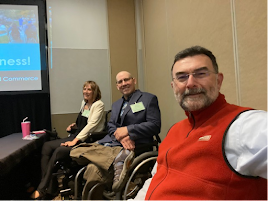
Members of the Idaho Access Project and Ramp Up Idaho presented "Access Means Business: Policies for Compliance, Community and Commerce" at the June 23rd Association of Idaho Cities Conference in Boise. 
Three smiling people pose for a selfie in front of a presentation screen. In the foreground is a man in a blue shirt and red vest. Seated to his right in the backgrounds are a man in a grey jacket in a manual wheelchair, and a woman in a light-colored jacket in a powered wheelchair.

We had a great turnout and audience questions about legal requirements, inclusive community engagement, local ADA transition planning, and the social and economic implications of accessibility and inclusion for retail,
   commercial and recreation/tourism businesses.

Access means business in employment, housing and community mobility. Ramp Up Idaho Co-founders and IAP Board Members Erik Kingston, PCED and Dana Gover, MPA, ADAC, were joined by fellow IAP Board Member and LINCIdaho Executive Director Jeremy Maxand, MA, ADAC.

Wednesday, October 6, 2021

Idaho Access Project featured on 'Affordable Housing Matters' podcast

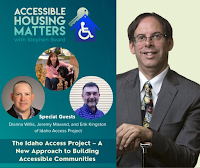
Image announcing the Idaho Access Project interview on Accessible Housing Matters, Interviewer Stephen Beard is pictured at right; on the left is the program title, with circular head shots of the three Idaho Access Project speakers

Members of the Idaho Access Project were recently interviewed by Stephen Beard, founder of Accessible Housing Matters. a podcast and website devoted to the importance of housing that's accessible to people of all abilities. Click the link below to listen to the interview!

Episode 20 - The Idaho Access Project – A New Approach to Building Accessible Communities

Be sure to listen to other interviews on this great podcast! 

Wednesday, September 15, 2021

Idaho Access Project

The Idaho Access Project is making things happen in Idaho. 

This small nonprofit is has cultivated partnerships with local and state government, small businesses, transportation and land-use planners, recreation and outdoor advocates, and even working with Boise State University. The group's all-volunteer board is actively engaged in multiple committees, task forces and networks...all as part of its mission to "...eliminate physical, attitudinal, and policy barriers to ensure people with disabilities can live, work, and play in our neighborhoods and communities."

The group recently presented a session called 'Count Us In: Planning and Design for Community Health, Mobility and Safety' for the 2021 Rocky Mountain Land-Use Institute.

Thursday, November 12, 2020

ADA 30 Idaho Interview Series- Ashley Olson


This week we visited with Ashley Lyn Olson, founder of wheelchairtraveling.com. Ashley shares her lifelong passion for outdoor travel and adventure with Erik Kingston (Idaho Access Project/RampUpIdaho) and Interpreter Lauren Seale (Idaho Council for the Deaf and Hard of Hearing).


Ashley has traveled the world for two decades, and her site features practical tips and resources organized by destination, interests, accommodations or transportation options. It’s clear that Ashley focuses on the experiences and people she encounters, from getting stuck in the middle of nowhere to being amazed by the natural beauty, access and hospitality of locals on a recent visit to New Zealand. We’ve included some of the links and resources discussed below. Enjoy!


#ADA30Idaho #WhatTheADAMeansToMe #AccessYourWorld
https://www.wheelchairtraveling.com | https://www.newmobility.com | http://www.splore.org | https://www.challengedathletes.org | https://www.etctrips.org | https://discovernac.org | https://idahoaccessproject.org | www.rampupidaho.org

Wednesday, October 7, 2020

Inclusive Planning and Design: A Dollars and Sense Issue

A common mistake in public and private infrastructure development is what I call 'planning behind.' That is, fixing mistakes made by not anticipating the needs or consequences involving a project or design in the planning stages. One common mistake involves building or permitting single-family homes that aren't visitable by potential tenants (or neighbors) that use wheelchairs. Adding a ramp to an existing home can costs thousands of dollars and rarely looks good, while designing a home with one zero-step entrance and an accessible bathroom on the ground floor can cost no more than an inaccessible design.

Planning behind is always more expensive and less satisfying than planning ahead with the right people at the table; this includes end users of all abilities, neighbors and anyone impacted by the project. Not every user moves through the natural and built environment the same way, so it pays to have a cross-section of residents and users sharing their perspectives up front.

Example: This bike offramp is intended to keep cyclists out of roundabout traffic. It routes bikes from the roadway to the sidewalk; once they use the crosswalk there’s an on-ramp to move them back to the road.


But...
For a pedestrian who is blind or low-vision and uses a cane, the design is a problem. This pedestrian ‘tracks right,’ using her cane to follow the right edge of the walkway to stay on track. The slight angle of the ramp seems normal at first, and the lack of any tactile change at the roadway means she is well into the oncoming traffic lane and into the raised lane divider before she realizes something is wrong. For this roundabout design there are four such ramps. The day we visited the Warm Springs corridor, we noticed several inattentive drivers on cellphones; at an intersection to the west of this location, several cars flew right through the flashing pedestrian signal. With a silent electric vehicle, there is no warning that a collision is imminent. It’s critical for planners and designers to include a variety of users with different perspectives to review and contribute to designs affecting connectivity, visit ability and safety. We should note that several people were watching traffic to ensure her safety. Her goal was simply to follow the sidewalk heading west as she would normally navigate with a cane. More videos from this Barber Valley Access Audit to follow. The full video is part of a larger project of the Idaho Access Project. www.idahoaccessproject.org

Friday, June 26, 2020

30 Years of the ADA!


Idahoans are celebrating 30 Years of Community Access, Independent Living, Employment and Activism through the Americans with Disabilities Act (ADA).

The COVID-19 pandemic means we're adapting plans for “Hands Around the Capitol 2020” to create a series of online events, beginning in July and continuing until the end of October. We welcome your involvement!

The ADA means people with disabilities are treated the same way as others. We'll use social media  to share stories of how the ADA empowers us to live the lives we want, and to celebrate the people who made it all possible.

The law expanded opportunities for 304,000 Idahoans with disabilities by reducing barriers, changing perceptions, and increasing full participation in community life. The ADA's promise can only be reached through shared to fully implement the ADA through education and outreach.

To help celebrate, follow activities on social media:
#ThanksToTheADA #ADA30Idaho #WhatTheADAMeansToMe

For more information or to share your stories, contact idaho30yearADA@gmail.com


Monday, June 1, 2020

Adaptive Recreation Creates Opportunity, Supports Local Economies

Paraskier making a sharp turn on the ski slope
MoveUnited.org
Even before the ADA was signed into law, people living with disability—and their families and friends—found ways to pursue interests in sports and the outdoors. There are many pioneers in the field, including Jim Winthers, a veteran connected to the 10th Mountain Division in WWII. He found models in Europe to help returning veterans learn to ski after losing limbs. As they say, necessity is the mother of invention, and where there's a will, there's a way...

As a former volunteer with Splore in the 80s, it was great to learn from the diverse client base about their personal motivations to get outdoors and ski, raft, climb or paddle. What stuck with me was a common request from folks using wheelchairs during overnight rafting trips on the Colorado River:
I'd like watch the river for a while and be alone...
We all benefit from solitude, the sensation of wind and sun or the natural sights and sounds of water, landscape and open sky. This doesn't change for those with disabilities involving mobility, sensory or developmental issues. The other thing I learned from fellow volunteers (who were wheelchair users themselves) was their value for roadless areas and wilderness—even when that meant they couldn't visit easily. While others might feel differently, the knowledge that those areas were preserved in a natural state was as important to them as it was to anyone else.

To get a sense of the experience of one wheelchair user running the Colorado—from an unintentional swim to using the camp 'groover'—see this piece featured on WheelchairTraveling.com, Rafting the Colorado with a Wheelchair, by John W. Mitchell.

As we all adjust to a world with #COVID-19, guides, outfitters and others in the recreation-tourism industry are anxious to accommodate clients again safely. With more than 12% of Idaho's population living with some form of disability, that's a market share worth welcoming into your lodge, shop, cabins, boat and restaurant. As we like to remind retail, travel and tourism professionals, by welcoming people of all abilities into your business or activity, you're also welcoming their entourage...friends, family, co-workers, etc.

Idaho is a state with exceptional recreational and landscape values—and an economy based largely on providing access to those places. Boise's Ridge to River trail system features several wheelchair-accessible trail segments that let more folks explore the landscape, fresh air and views around the city.
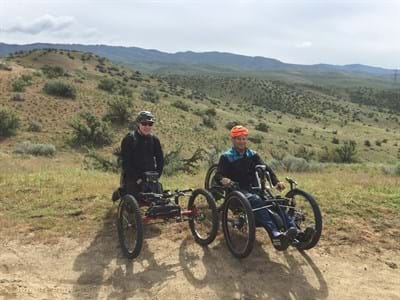
Two adaptive cycle users stopped on a foothills trail overlooking the City of Boise.
Copyright, Ridge to River

Splore is now part of the National Ability Center. One look at their program list will give anyone a sense of the potential available to both individuals and local businesses. Whether it's hunting, fishing, skiing, bird watching or boating, Idaho has much to offer.

And in some cases, outdoor recreation depends on simple policies and community support and engagement. As community members, we should all consider the landscapes we move through and pay attention to basics: trail width and surface, potential hazards from high-speed bike traffic, and designated ADA parking options and entries to trail segments considered 'accessible.' It's time to demand more inclusive planning and design of our use of the natural and built environment funded and used by the public.

We all benefit from time outdoors in many ways: physically, mentally, emotionally and spiritually. It's not a matter of altering open space to remove all risk; it's a matter of making changes that promote more inclusive exploration. As the original Splore web site puts it so well,
...there is dignity in risk-taking and that it is an inherent part of living a full and robust life.

Woman and guide dog navigate downhill sandy trail flanked by dry grass with blue sky above.
Photo, Erik Kingston


Access Means Business, Access Means Inclusion, Access Means Adventure, Access Means Freedom

What are we waiting for?

Sunday, October 27, 2019

When bridges become barriers


During a 2019 hashtagaccess audit in an east Boise, ID subdivision, hashtagplanning and hashtagdesign barriers were evident throughout the 'walk and roll' event. From the absence of Greenbelt access indicators to steep connecting ramps, missing or misaligned curb cuts, and even surface materials, the team encountered multiple opportunities for improved mobility and access. Take the bridge decking in the photo above. The openings are the perfect size to trap small front wheels on a manual chair or swallow the tip of a cane. It's also a surface service dogs might perceive as unsafe. This is a perfect example of the need to include a range of voices in the planning process. Until you've tried to navigate your community without full vision, hearing or mobility, access is often an afterthought. Construction can create life-threatening hashtagbarriers and hazards, as in this 2018 story about ongoing hashtagtransportation projects. (https://lnkd.in/g7XPUhc) Highway signs in the path of travel can trip a pedestrian or force them into the roadway. This is not a mere inconvenience; we all need to increase our access awareness and take an active role in creating barrier-free communities.

Tuesday, May 2, 2017

Convertible powered ramps/walkways provide access in tight spaces

An interesting product idea that could be an answer in some situations. Here are the descriptions from a couple of YouTube videos posted by the manufacturer. See more at www.lift-u.com

"The Accessor Convertible Walkway (ACW) is designed to provide access where building conditions will not permit the use of a permanent ramp or lift. The initial design intent was to provide access to buildings in older areas of many cities that, heretofore, could not be made accessible. The initial product designs were for exterior applications. However, a number of interior applications have been identified and more are being discovered for this new accessibility solution.
For more information, visit www.lift-u.com or call 209-838-2400.
*General Features*
1. Surface mount—no pit required.
2. Thin stowed profile—less than 1-inch thick.
3. Platform parks in the horizontal position until needed.
4. Counterbalanced for power drive efficiency.
5. Operable undercarriage closeouts.
6. Standard slope is 1:12 unless the application dictates otherwise (i.e., space constraints).
7. 1:18 tapered threshold on 3-sides"


See the convertible ramp here.

"The Accessor Convertible Walkway (ACW) is designed to provide access where building conditions will not permit the use of a permanent ramp or lift. The initial design intent was to provide access to buildings in older areas of many cities that, heretofore, could not be made accessible. The initial product designs were for exterior applications. However, a number of interior applications have been identified and more are being discovered for this new accessibility solution."

See the convertible walkway here.

Friday, May 16, 2014

Reaching Out Persons with Disabilities - Ten Lessons

Parents, grandparents, and children arrive at a hotel for vacation.
Some great information from the ADA for small business. Getting people in the door is just one aspect of expanding markets and providing goods and services to persons living with disability.

"Did you know?

  • More than 50 million Americans with disabilities - 18% of our population - are potential customers for businesses of all types across the United States.
  • This group has $175 billion in discretionary spending power, according to the U.S. Department of Labor. That figure is more than twice the spending power of American teenagers and almost 18 times the spending power of the American "tweens" market.
  • Accessibility attracts not only people with disabilities but also their families and friends. Like others, these customers often visit stores, restaurants, movie theaters, and other businesses accompanied by family or friends. This expands the potential market exponentially!
  • This market is growing fast. By the year 2030, 71.5 million Baby Boomers will be over the age of 65 and demanding products, services, and environments that address their age-related physical changes."
http://www.ada.gov/reachingout/intro1.htm


Monday, December 2, 2013

Cycling infrastructure means new pathways for all

Check out this video of cycling infrastructure, or 'infra,' in the Netherlands. A leader in bike- and pedestrian-friendly communities, Dutch culture is equally friendly in terms of universal access. Both stakeholders that use wheelchairs and cyclists find common cause in advocating for safe routes that connect neighborhoods, communities and recreational amenities.

As Idaho's statewide Bike and Pedestrian Advisory Committee (BPAC) and other mobility planners explore options to expand transportation choices, keep this video in mind. To learn more, call Erik at 208.331.4706.

Who else benefits from Dutch cycling infrastructure?
http://www.youtube.com/watch?v=xSGx3HSjKDo

(Photo: Chuck Humel)
Some ingenious ways to combine bike and wheelchair commuting with friends and family:
(Photo: tmannetje.nl)
See also: http://www.frankmobility.com/duetfeat.php

Friday, November 22, 2013

When Vancouver Leads, Access Follows


Ideas that are long overdue. A similar single-family residential ordinance was adopted officially in Pima County, AZ years ago and has withstood court challenges. Lever hardware is rapidly becoming the norm (no knobs in my house!), and we can expect hardware makers to get more creative and artful as lever use expands.

As I've often said, we are all seniors in training (if we're lucky), and aging-in-place is good for us, our families and for the public treasury. Habitat for Humanity has said it will build all homes to 'visitability standards' (at least one zero-step entry and accessible route to a sleeping area and main floor bathroom). Whether through age, illness or injury, we will all face mobility restrictions at point in our lives. And there's no place like home.

Monday, November 18, 2013

Idaho Loses Long-Time Advocate

Idaho lost a tremendous disability rights advocate and expert, and many of us lost a friend and mentor this weekend. Bobby Ball had a long history working to preserve and expand opportunities for persons living with disabilities through technical assistance and the legislative process. As the Director of the ADA Task Force, Bobby brought together partners from many background. Her wonderful smile and persuasive ability made it tough to say no, whether she was asking for volunteer time or resources to make Idaho more accessible and welcoming.

Thank you, Bobby, for all your hard work, dedication, great sense of humor, and the inspiration you have been to so many of us. We will miss you.

To learn more about Bobby, see this brief feature story when she was recognized as one of Idaho's 'Women Making History.'

http://womenscenter.boisestate.edu/women/women-making-history/2009-honorees/bobby-ball/

This brief 10-second clip was captured during the ADA celebration at the Idaho Statehouse in 2010

http://youtu.be/ukDiISj8qHo

Friday, November 15, 2013

Brochures, Information Sheets Available for Download!

Although it's been a while since the last post, things are moving forward. Here's a brief update on Ramp Up Idaho (RUI) activities:
  • RUI partners presented at this year's American Planning Association Conference in Idaho Falls
  • Cards and brochures printed and distributed via trade shows, NW ADA conference, Community Review visits and regional housing roundtable meetings
  • Presentation to Boise Fair Housing Task Force.
We've been getting requests for promotional materials from communities and organizations around the state. Small quantities of brochures or business cards are available on request, or you are free to download and distribute information as need using the links below:

Data sheets/brochures
Call 208 331 4706 for more information.


Tuesday, October 8, 2013

New Brochures, New Outreach

Ramp Up Idaho brochures are now available on request, along with RUI cards featuring contact information. If you or your organization would like to help spread the word to regional business groups (i.e., local and regional Chambers of Commerce, Business Districts, etc.), please let us know. Quantities are limited, but we will do our best to get you what you need.

RUI team members will be presenting information on community and retail access to the Idaho Chapter of the American Planning Association conference this week in Idaho Falls. Stay tuned for more updates!


Tuesday, September 10, 2013

NW ADA Conference in Boise Sept. 19, 20 - Register Now!

(From the DBTAC site):

Communities Celebrating Equal Access and Employment Through the ADA

Learn how the Americans with Disabilities Act in 2013 is reshaping opportunities for citizens with disabilities.  The Northwest ADA Regional Conference will bring together an impressive array of speakers to Boise, touching on many of the topics important to our work and play.
Whether you run a business, manage a hotel, work for local government, or have a disability and want to enjoy the recreational opportunities of Idaho, this conference offers excellent information.  Hear experts from the Department of Justice, the Equal Employment Opportunity Commission (EEOC), the Access Board, and from the Job Accommodation Network, as well as regional authorities. 
Idaho in September is beautiful and registration is limited. Check out the agenda and speakers to confirm that this conference is the one you don’t want to miss.
Featuring Nationally Recognized Speakers:
Sally Conway
U.S. Department of Justice
Beth Loy
Job Accommodation Network
Peggy Greenwell
U.S. Access Board
Sharon Rennert
Equal Employment Opportunity Commission
Richard Pimentel
Nationally Renowned Speaker and Advocate
This two-day event will be held at The Grove Hotel in downtown Boise, ID. The conference will offer four keynote sessions as well as 16 breakout sessions on a variety of topics, including:
  •     Employment and People with Disabilities
  •     Role of the ADA Coordinator/ADA Title II
  •     Accessible Outdoor Recreation
  •     Effective Communication
  •     Assistive Technology
  •     Service Animals

Regisratation Cost: $175
(includes lunch and refreshments)
Register Here

Conference Location
The Grove Hotel Downtown Boise

The Grove Hotel
245 S. Capitol Blvd
Boise Idaho 83702

Room Block is available at the Hampton Inn & Suites Boise
Room rates are $130 Online hotel registration

For Content Information:
John Dineen dineej@uw.edu

For Registration Information:
Tammi Olson tammio@uw.edu